
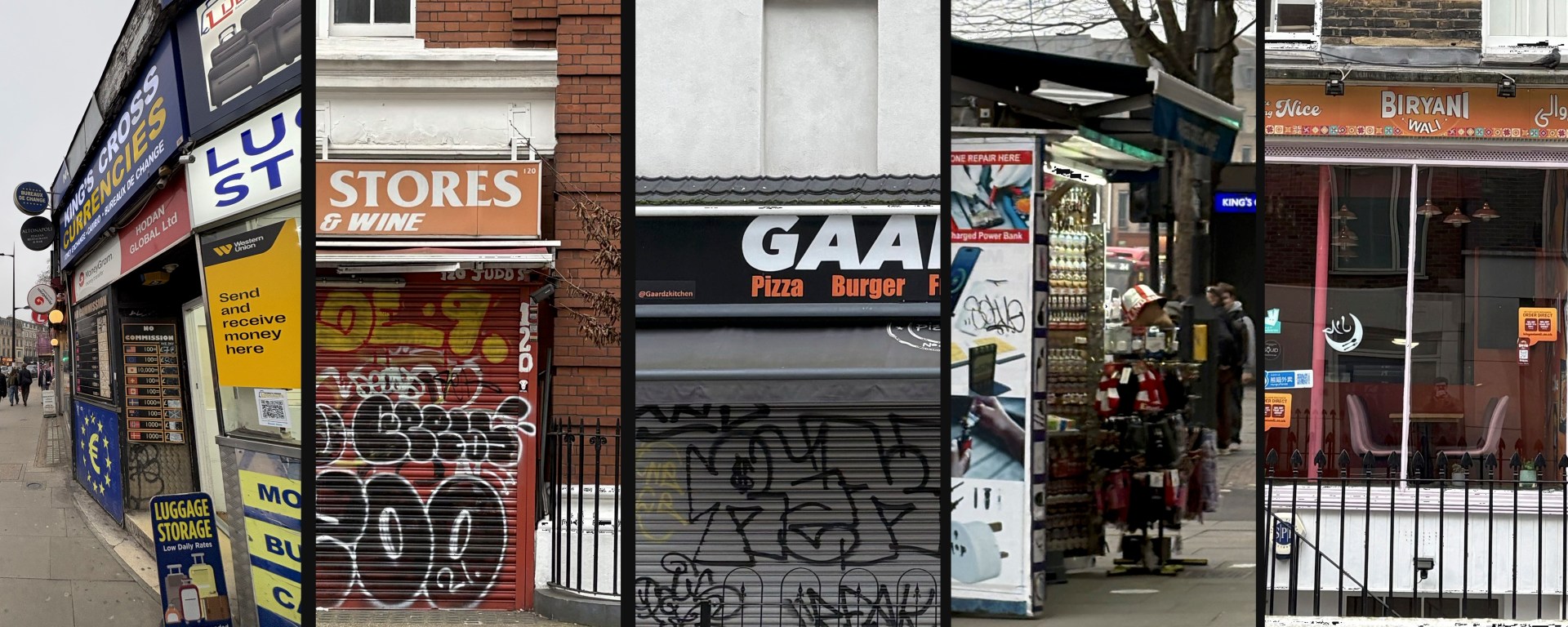
A 5-year review of 96 commercial sites in Bloomsbury and King’s Cross shows 45 with an outstanding planning breach in 2026. Of the 35 originally identified in 2021, Camden succeeded in remediating only 6, with 1 site demolished, 1 repossessed, and 18 new breaches. Breaches range from excessive advertisement to unauthorised changes of use and listed building offences. Offenders include the likes of Morrisons, Subway, and the Democratic Republic of Congo, and currently stand at 48% of extant surveyed properties.
Introduction
It has been well-known informally for quite some time that Camden’s enforcement against planning breaches is poor. Among conservation and community groups, this has led to a sense of there being ‘no point’ in reporting new breaches, while the rate at which new breaches arise is particularly concerning in commercialised areas. Reports are only made in fairly exceptional cases, such as in the case of a new listed building offence, or in areas with an exceptional level of community monitoring, such as in Seven Dials.
However, there appears to have been no general investigation into the efficacy of enforcement in Camden, nor any monitoring of ongoing breaches. Camden’s online record of enforcement notices is unreliable and inaccurate, being completely inconsistent with statistics submitted in their own performance reports. As such, there is no way to know how many enforcement cases have been reported or successfully actioned in the central areas.
The performance of planning enforcement is of particular relevance as Camden prepares for the public examination of its draft new Local Plan. This includes a draft new Enforcement Plan which will be used to inform Camden’s enforcement approach in the coming years, with the aim of ensuring the Local Plan is not undermined by breaches of planning control.
The aim of this article is to shed some light on the efficacy of enforcement in Camden and particularly the central areas. This is achieved by examining the enforcement status of 96 commercial sites in Bloomsbury and King’s Cross over the period 2021-26. In particular, we can consider the following questions:
- How many planning breaches go unreported?
- How many enforcement reports result in a positive outcome?
- Is a lack of public confidence in enforcement justified?
Legal background
It is worth giving a brief overview of the legislative and policy background to enforcement in Camden and nationally, particularly with regard to commercial premises which this study concerns. Skip ahead if you are an exceptionally ‘educated reader’.
Advertisements
Commercial sites benefit from a number of automatic permissions for common forms of advertising. Display of an unlit fascia or projecting sign does not generally need permission. However, illumination of a fascia or projecting sign (external or internal) does require advertisement consent in a conservation area.
There are two main caveats to this. Firstly, if an illuminated sign replaces a previously consented illuminated sign, and is not larger than the previous sign, consent is not generally required. Secondly, any form of illuminated sign can be displayed within the shop without consent, including directly behind the shopfront glass.
If an unauthorised advertisement is displayed continuously for a period of 10 years, it then becomes immune from enforcement action. The considerations above then apply, i.e. in the case of an unauthorised illuminated sign displayed continuously for 10 years without enforcement, the sign can then be replaced with a new illuminated sign of similar scale, despite no application having ever been made on the site for consent. This, incidentally, is why many ‘box lit’ signs remain across conservation areas, as they technically benefit from advertisement consent.
While the above considerations apply to conservation areas as a whole, if the property is listed then a further listed building consent is required for any such advertisements, new or replacement. The duty to preserve the listed building then applies. Listed building breaches do not ever become ‘immune’ from enforcement; theoretically an unauthorised advertisement on a listed building can receive enforcement action 20 or 30 years later.
Any form of advertisement above ground floor level requires permission, along with the display of any business-related flag in a conservation area.
Changes of Use
There is also pressure for changes of use from commercial to residential across the CA. While this is usually permitted development, Camden’s Article 4 direction removes this right, meaning a full planning application is required. However, should a shop be changed to a flat illegally, and no enforcement carried out within 10 years, then the change of use also becomes ‘immune’ from enforcement action.
Somewhat unusually, immunity from enforcement also applies to listed buildings in this case. This is because listed building consent is not required for a change of use alone. If a listed shop changes to a flat without permission, and no enforcement is taken within 10 years, the flat becomes ‘legalised’ and immune from enforcement.
Any other alterations
Alterations to or replacements of shopfronts usually require planning permission, and additionally listed building consent in the case of a listed building. Internal alterations to shops in a listed building also generally require consent.
Background to the study
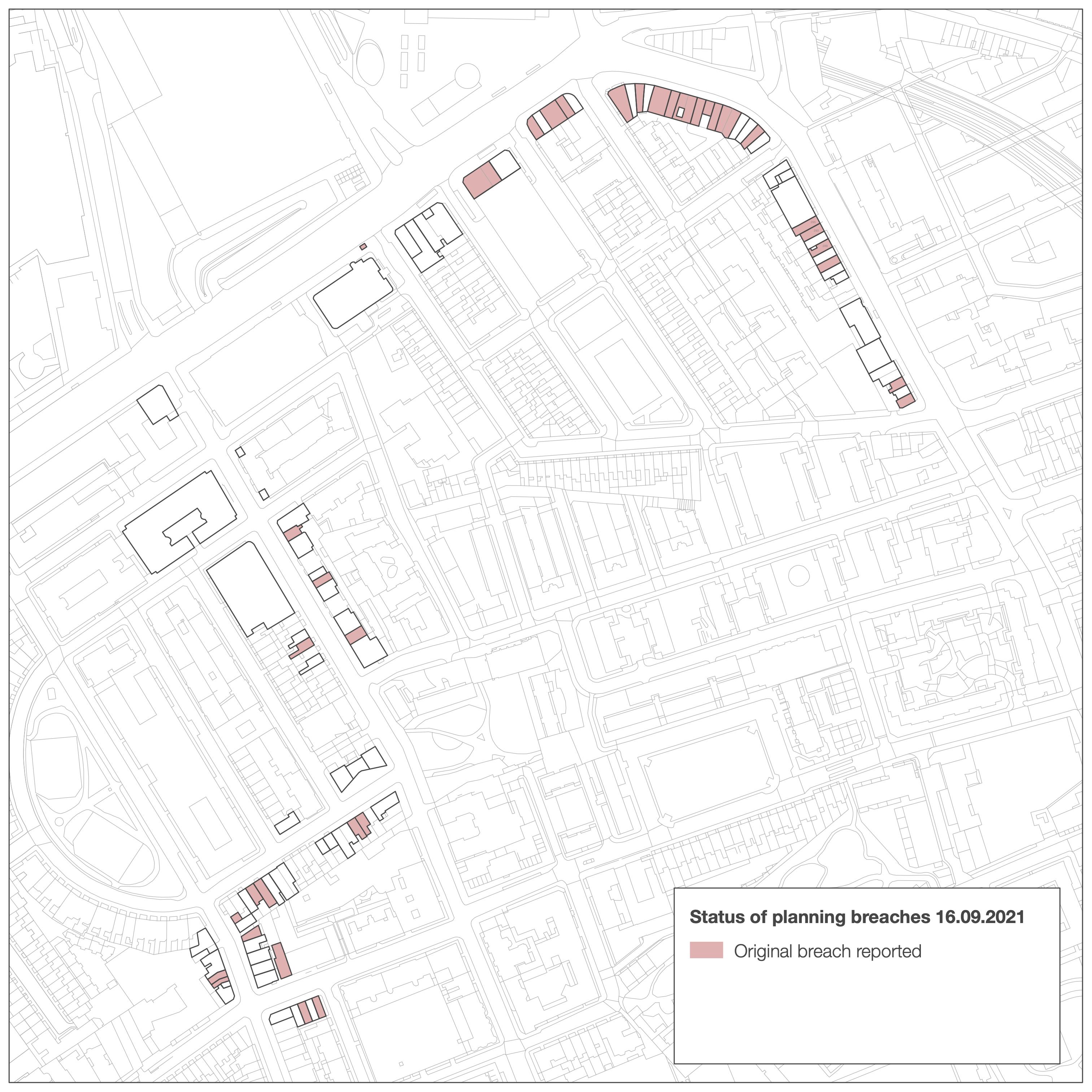
In June 2021, the Bloomsbury CAAC began a project to comprehensively report all visible enforcement breaches across their conservation areas. The background to this is explained in an earlier post on this site. I undertook the initial work with Marianne Jacobs-Lim, with outside advice from Alec Forshaw. The first phase of the work comprised two walkarounds, one of them with Camden’s enforcement team, to identify enforceable breaches. This initially focused on a stretch of about 1km from Marchmont Street to Gray’s Inn Road.1 Following this initial ‘screening’ of 96 commercial properties, reports in relation to 38 properties were made. 35 breaches were identified, with 31 enforcement cases opened.2
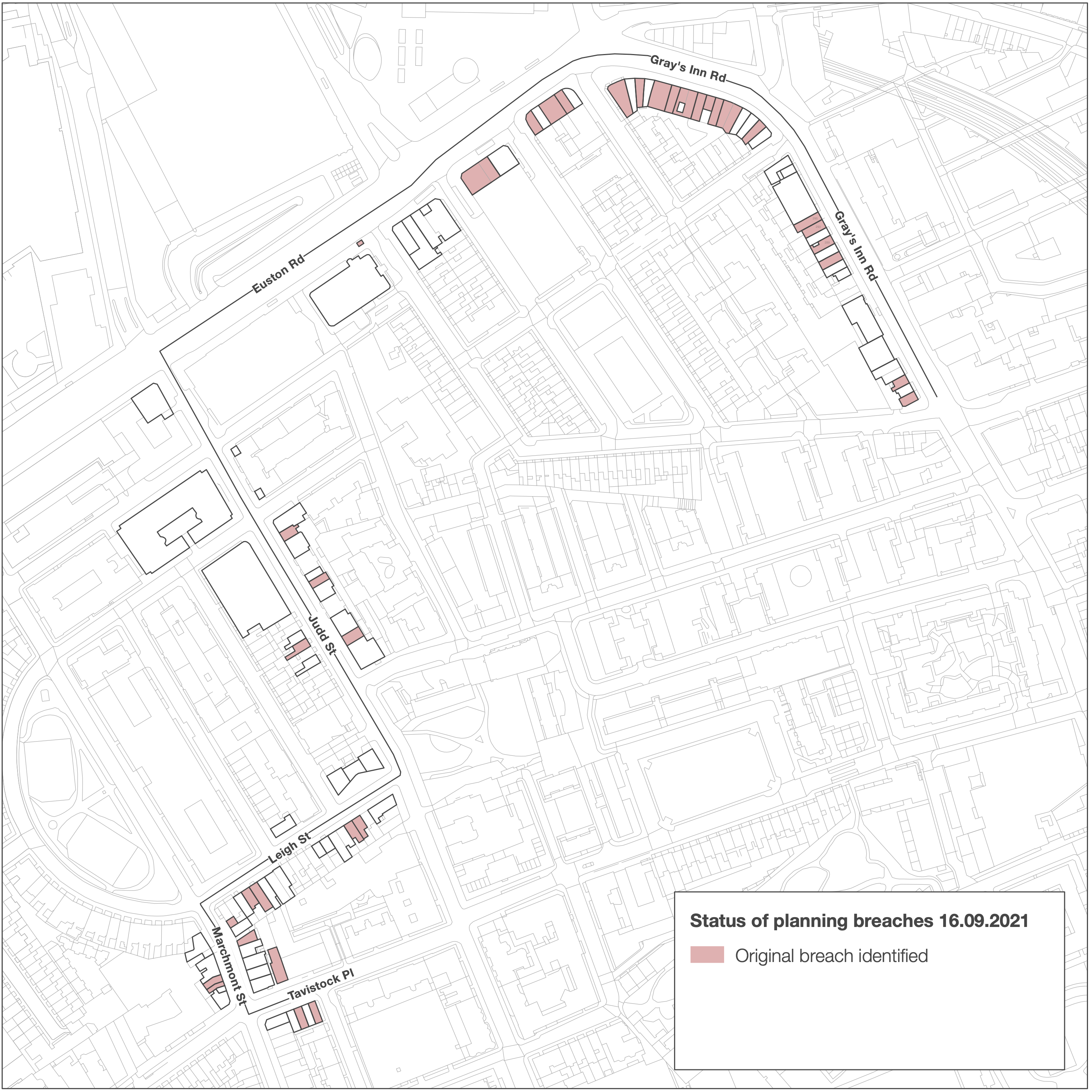
The 35 breaches initially recorded can be broken down as follows:
- 24 unauthorised advertisements only
- 4 unauthorised advertisements on and associated alterations to a listed building
- 3 unauthorised alterations to shops/shopfronts
- 2 suspected unauthorised changes of use of a listed building
- 1 unauthorised alteration to a listed building (painting of plinth in business colour scheme)
- 1 case of excessive graffiti on a shopfront requiring removal
It was not until November 2021 that any update was provided from Camden regarding these initial reports, and officers indicated a reluctance to accept any more reports due to the workload and wider resource pressures addressing enforcement across the borough. One further update was provided in June 2022. In these updates the council indicated several letters had been sent to business owners and indeed that many of these businesses had removed offending signage and addressed the concerns raised in the initial reports.
However, it was apparent that the majority of these businesses had simply reinstated the concerned signage a matter of weeks or months after it being removed, without Camden realising this, despite some of these premises being within a stone’s throw of the Town Hall. Any genuinely ‘successful’ outcome at the one-year mark pertained to very minor breaches of control without addressing the more pressing matters, particularly with regard to listed building offences or unauthorised changes of use. Given the challenges the authority faced in addressing a minuscule proportion of the wider conservation areas, the decision was made by the Bloomsbury CAAC not to pursue the project any further, as it was not achieving any useful outcome. The initial aim of addressing all visible planning breaches across the central areas was clearly unrealistic.
5-year review
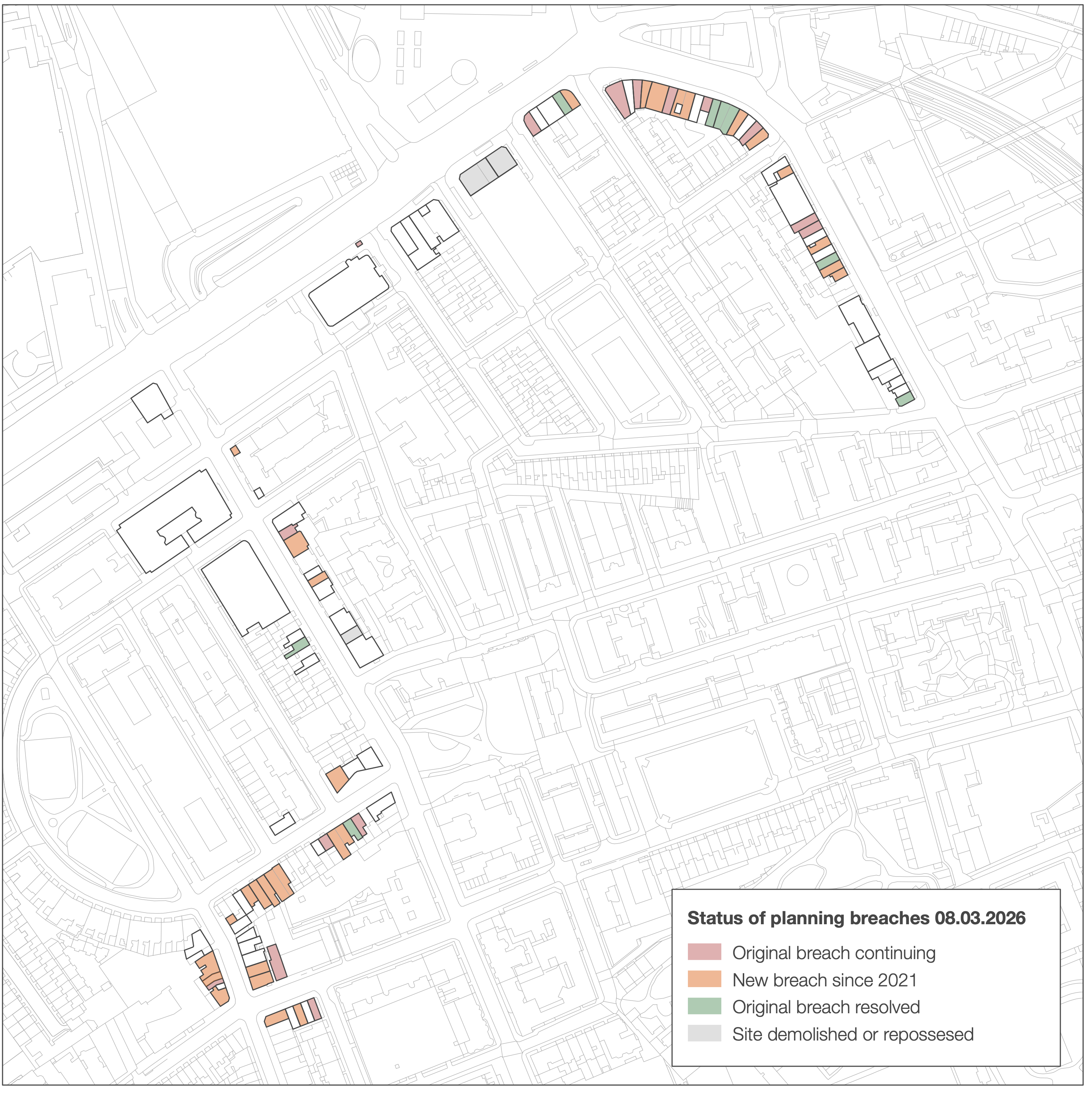
Despite the failure of the project, the initial reports and Camden’s enforcement approach in each case provide a very useful dataset for comparison with the present day. As such, these sites were individually re-reviewed on 08.03.2026 to assess whether the originally reported breaches had been addressed and/or whether further breaches had taken place on any of these sites.
The results of this survey are plotted on the below map. Not only had a very small number of breaches been resolved in the long term, but a significant number of new breaches had occurred both on the originally-reported sites and on sites not previously subject to any breaches. Approximately half of the originally surveyed properties are now subject to a potential planning breach (up from 36%), with the proportion far higher in areas where breaches had previously occurred, suggesting a sort of viral ‘spread’ of poor planning control to nearby properties.
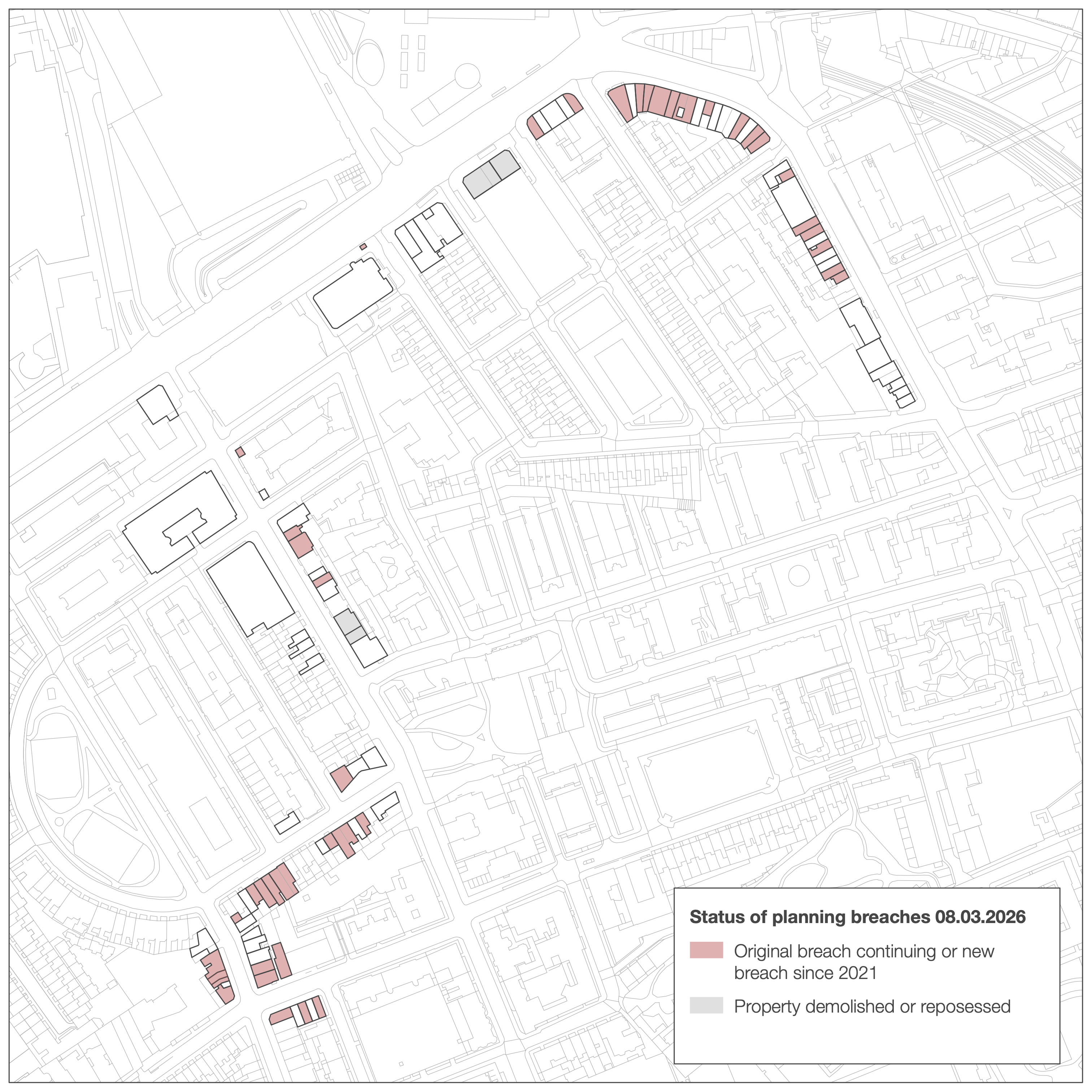
The figures can be broken down as follows:
- 6 breaches were resolved
- 17 of the original breaches remain as originally recorded or slightly worsened
- 28 new breaches, 18 of those on new sites previously unaffected by a breach
- 2 sites in breach were demolished or repossessed
- 2 sites not subject to a breach were demolished or repossessed
- 7 sites made legal alterations approved at planning, or benefitting from deemed consent
- 1 site was ‘incidentally resolved’ by a new owner removing an offending sign as part of a rebrand
- 33 sites not originally in breach remain unchanged
As such, 45 of the remaining 94 properties are subject to a suspected or clear breach:
- 25 relate to advertisements, signage, and lighting only
- 10 relate to unauthorised alterations/replacements of a shop/shopfront
- 4 relate to advertisements and associated alterations to a listed building
- 2 for a suspected, unauthorised change of use of a listed building (unchanged from previous assessment)
- 2 for unauthorised internal alterations to a listed building
- 2 for excessive clutter, graffiti, and fly-posting
Analysis
Given the lack of availability of data on enforcement reports and notices served, it is not clear how many of the subsequent breaches have been reported or are subject to some sort of enforcement action. Nevertheless, the numbers paint a stark picture of the state of enforcement in the area, largely consistent with community opinion. This is particularly pertinent considering these sites were subject to a focused project to reduce planning breaches. Not only has a reduction not occurred (either in the short or long term), but breaches have increased by about one third.3
Even of the 35 originally reported breaches, only 6 were resolved in the long term, with 1 further site being ‘incidentally’ resolved by a subsequent owner’s rebrand, after the previous owner had not complied with enforcement action. The remaining 28 breaches continue unabated with no change whatsoever, or indeed have worsened significantly. Even if enforcement action continues behind the scenes (which appears unlikely, given the timescales involved), this action has been entirely ineffective.
In particular, there appears to be significant inconsistency with Camden’s own borough-wide monitoring of enforcement action. At their latest assessment, around 45% of reported breaches are closed within 16 weeks. There are no exact statistics on long-term outcomes, but the report paints a general picture of all enforcement reports eventually being actioned informally, formally, or closed due to a lack of breach. But the above results show a significant ‘leakage’ of reports being made which result in no apparent closure, despite a breach being acknowledged and action being initiated. It seems, on balance, that Camden have simply ‘forgotten’ about the majority of cases initially reported in 2021.
The increase in planning breaches is also significant, with 18 new clear or suspected breaches on sites which were assessed as compliant in 2021, accounting for a 33% uplift per property. Not only is the progress and outcome of enforcement poor when reported, but the rate at which new breaches arise far outpaces any meaningful outcome of enforcement action. Over the 5-year study period, for every one breach resolved, 3 new breaches were committed. These statistics are clearly unsustainable, and substantiate community concerns about planning breaches being ‘out of control’.
‘Token enforcement’
Of arguably more concern is that the 6 cases which were resolved pertain to only very minor breaches of control, with the most harmful cases unresolved. Just 1 of the 7 original reports relating to listed buildings was successfully actioned, and since 2021, 4 further listed building offences have been carried out, with one of those ongoing at the time of writing despite a report being made on 2nd March.
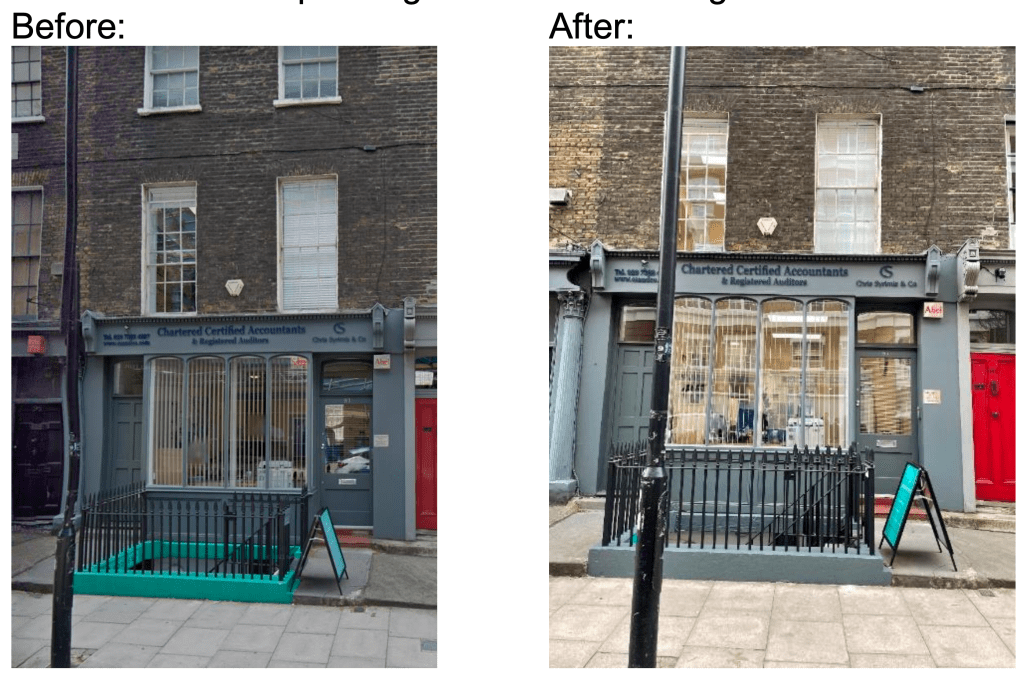
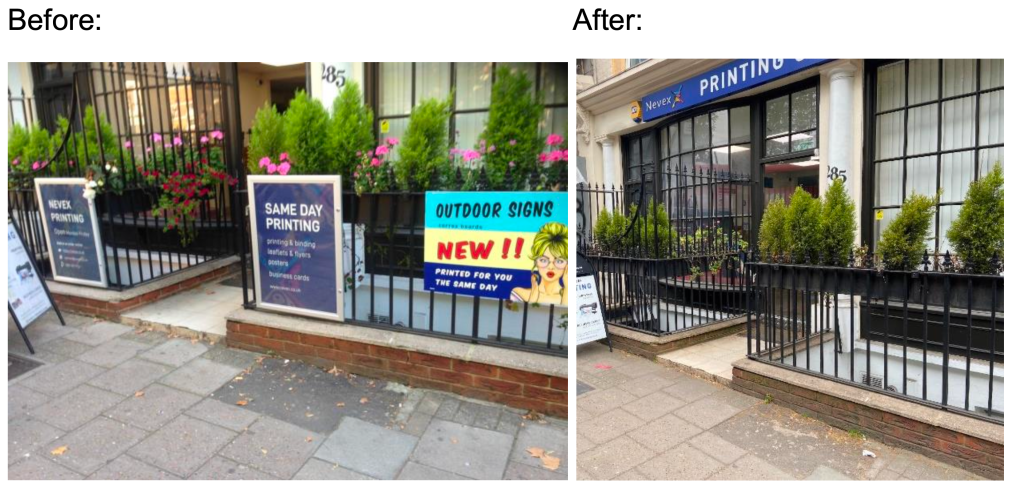
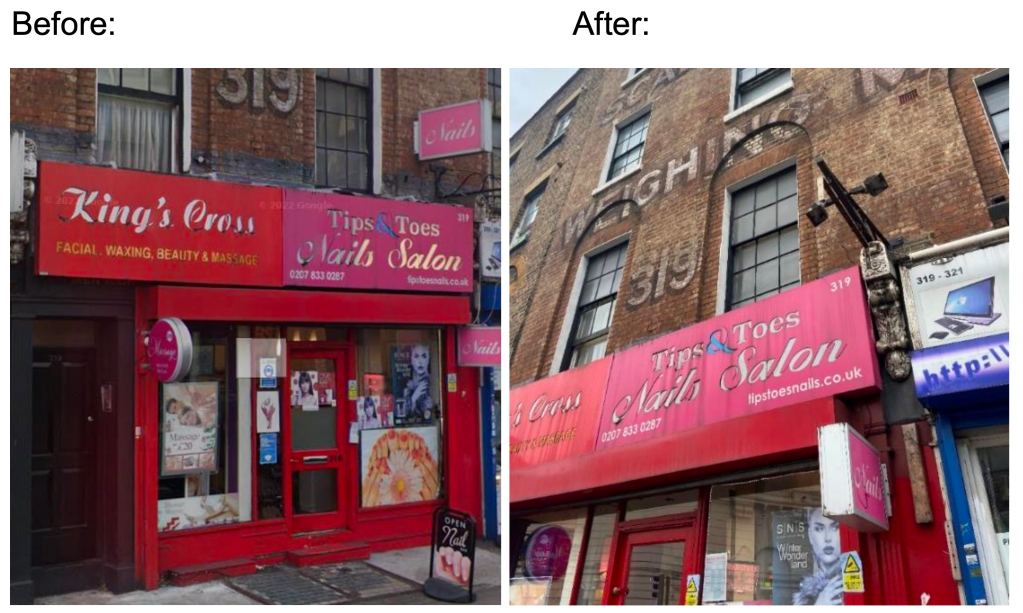
Furthermore, there are no cases where a substantial breach of planning control was actively resolved at all, rather, only very minor and incidental breaches were successfully addressed. In the case of the listed building breach, this pertained to a painted plinth to railings which was simply repainted. In the 4 advertisement cases ‘resolved’, only incidental signage at high level or attached to railings was removed (or simply moved). In no cases was an offending principal fascia or projecting sign altered. In the one further case of an unauthorised shopfront, a retrospective application was simply approved at planning rather than any remedial action being taken (3 Euston Road).
As such, there appears to be either reluctance or more difficulty in enforcing meaningful outcomes, where remedial work could have a more substantial financial impact – either on the business owner or council. Evidently, the moving or removal of a sign, or repainting of a plinth, essentially falls into the realm of DIY, whereas replacement of a fascia or remedial work to a listed building is far more costly. This leads to a perception of ‘token enforcement’, where even in the case of a successful outcome, this has an insignificant effect on the area as a whole, or even the site in question.
Lack of follow-up
Even in the cases where formal enforcement action was pursued, leading to a refusal of planning permission, the issuing of an enforcement notice, or the winning of an appeal, there has been a distinct lack of follow-up from the council, with the businesses simply continuing the breach which had been ‘successfully’ resolved through formal action.
In one case where retrospective consent for signage was refused, the owners simply did not remove the signage (112 Judd St), with it still in place almost 4 years after refusal (2022/0723/A). In another case where retrospective planning permission was approved for an unauthorised shopfront and advertisements (327 Gray’s Inn Rd), the owners indicated the signage to be externally illuminated, but instead continue to illuminate the sign internally while also uplighting the facade (2020/5307/P and 2020/5799/A). In one further case where an enforcement notice was upheld at appeal, the new shop-owners have continued carrying out the breach with no change, even reinstating the same railings which had previously been removed during enforcement action (98 Marchmont St, EN24/0081) and seemingly continuing the unauthorised change of use.
And while it is true that the majority of breaches are carried out by small businesses, who perhaps hope to ‘fly under the radar,’ this is not always the case. At 335-337 Gray’s Inn Road (formerly Nisa, now Morrisons), advertisement consent was refused for the installation of an ATM in the shopfront, with an appeal by Nisa dismissed (2022/1106/A and APP/X5210/H/22/3301283).4 But an ATM was nonetheless installed, and remains in place. Subway (311 Gray’s Inn Rd) replaced non-illuminated signage with internally illuminated signage without any consent. Most bizarrely of all, the Democratic Republic of Congo appear to have replaced the ‘shopfront’ to their embassy (281 Gray’s Inn Road) and installed an internally illuminated sign without any form of consent.
As a whole, even in the minority of cases where enforcement action is pursued (formally or informally), the lack of proper monitoring and follow-up leads to poor outcomes, and in some sense, the missing of an open goal. In informal cases, there appears to be an overwhelming tendency for enforcement cases to be ‘forgotten’ after some years, while in those cases where informal action is successful, business owners often reinstate the offending works a matter of weeks or months later, without Camden realising this. In the few cases where formal action was pursued, and was successful, business owners have continued committing the same breach, again, without Camden appearing to realise.
Conclusions
Both by looking at the statistics and at the detail of these enforcement cases, it is clear there is something of a ‘crisis’ in enforcement. While it has been well-known for some time by community groups that planning breaches are a regular occurrence in the area, the extent of these breaches is somewhat unprecedented. Almost half (48%) of extant properties in the study area are now subject to a clear or suspected planning breach, while for every 1 breach resolved, 3 further breaches have been committed. If these statistics hold in other commercial areas across Camden, which seems a reasonable assumption to make, then the integrity of the planning process is quite significantly undermined.
In particular, it is clear that from a business-owner’s point of view there is very little need to apply for consent for advertisements or shopfront alterations/replacements. It is a viable, more flexible, and much simpler option to just carry out the works while hoping to fly under the radar – even where those works concern a listed building. This appears to be the case adopted even by some chains and international businesses, who cannot reasonably claim to be ignorant of the law.
Even when a report is made, and informal or formal action is pursued by the council, there is no guarantee of any remedial work being necessary. Informal works can simply be reverted with no consequence. Formal action can be effectively ignored with no follow-up from the council.
Given the findings of this brief study, it is reasonable to conclude that community scepticism regarding planning enforcement is justified. There appears to be little ‘point’ in making enforcement reports. The majority of these reports appear to go un-actioned, and even where action is pursued, it results in transitory and insignificant benefit when compared to the enforcement problem as a whole.
Improving monitoring
Perhaps the key theme in this study is the very poor quality of monitoring from Camden’s enforcement team. While there is a degree of desk-based monitoring, with the submission of performance reports detailing action timelines and outcomes, these appear to be based mostly on a spreadsheet or database, without any checking/monitoring of what actually has occurred on the concerned site. Analysis of spreadsheet data without checking that it tallies with what is ‘on-the-ground’ is clearly something of a tick-box exercise. Both in informal and formal cases, it is of paramount importance to inspect sites to check whether enforcement outcomes have actually been achieved, both in the short and long term.
Similarly, Camden appears to rely almost exclusively on community monitoring and reporting of planning breaches, while undertaking little pro-active monitoring themselves.5 This is problematic for two reasons. Firstly, community members cannot be expected to understand the intricacies of planning law, and may not realise that a planning breach has taken place. This is particularly pertinent given the somewhat convoluted regulations surrounding advertisements outlined at the start of this study. Secondly, this relies on an active community to make reports and to continue to make reports when further breaches occur. If the reporter of a planning breach is faced with an unresponsive department, and no short or long term remediation, it seems unlikely that they are going to continue making reports. This, naturally, can lead to a negative spiral in areas of high planning breaches.
There is also no apparent monitoring of the gap between reports made and the number of breaches occurring, nor any (published) monitoring on the long term outcome of planning breaches. This study suggests that there are significant issues in both areas. It would be useful for Camden to make some reasonable estimates of the discrepancy between reported breaches and actual breaches, to inform the extent of pro-active officer monitoring required. Similarly, data should be published on the long-term outcomes of all planning breaches recorded, rather than only the number of breaches reported or closed within a year (without any tallying up of reports made in previous years).
In the case of planning applications, all this information (and much more) is readily available online through a text-based and map-based search, along with an OpenData database which is further accessible through an API for live web-based monitoring and data analysis. In the case of enforcement, only an elderly text-based search is available, which is unreliable and completely inconsistent with the statistics contained in Camden’s enforcement performance reports. Provision of similar technology for enforcement cases would help to make enforcement processes in the borough far more transparent, while further aiding community monitoring in actually providing a means to check the progress of reports made. At the very least, the enforcement notice register should be updated/repaired to actually include the full number of enforcement notices issued, to avoid providing actively misleading information online.
In this sense, simply focusing on proper and transparent monitoring would help to resolve many of the issues found in this study. But significant work still remains to address the cumulative harm caused by a lack of monitoring and action to date. Whether any motivation or indeed resources exist to do this remains to be seen.
Acknowledgements
Many thanks for Alec Forshaw for verifying my understanding of the advertisement regulations.
Data
Footnotes
- Incidental reports relating to a further 5 sites were made across the wider CA. These are excluded from the analysis for simplicity. ↩︎
- 3 breaches were found to be immune from action. In 3 further cases, Camden declined to take action despite an accepted breach. ↩︎
- 36% to 48% represents a 33% increase in the number of properties subject to a breach. ↩︎
- For some reason, the associated planning application appeal was upheld (2022/0491/P, APP/X5210/W/22/3304919). Nonetheless, there is no advertisement consent in place for the ATM signage, so it remains an unauthorised alteration. ↩︎
- Camden do undertake some pro-active monitoring, e.g., in relation to short-term lets / ‘Airbnbs’, but it seems from their Enforcement Plan that the vast majority of cases arise from community reports. ↩︎
 Save Bloomsbury